
Every piece of clothing in your wardrobe carries a rich, fascinating story of craftsmanship and dedication. The journey from cotton field to closet reveals the remarkable transformation of simple natural bolls into the comfortable, stylish garments you wear every day. Understanding this inspiring process connects you directly to the hands, innovation, and artistry behind conscious modern fashion.
From Cotton Field to Closet: How Your Favorite Blue Jeans Are Made
Look inside your closet right now. You will almost certainly find at least one pair of blue jeans. Maybe you are even wearing a pair as you read this. We wear jeans to work, to school, and on the weekend. They are tough, comfortable, and go with everything.
However, few of us stop to think about where our jeans actually come from. It is pretty amazing when you think about it. Your tough, blue pants actually start out as a soft, fluffy white plant growing in the dirt.
Over 150 years ago, two men named Jacob Davis and Levi Strauss invented the first blue jeans. They made these tough pants for gold miners and cowboys who needed clothes that would not rip easily. Back then, jeans were strictly work clothes. Today, nearly everyone on the planet wears them for style and comfort.
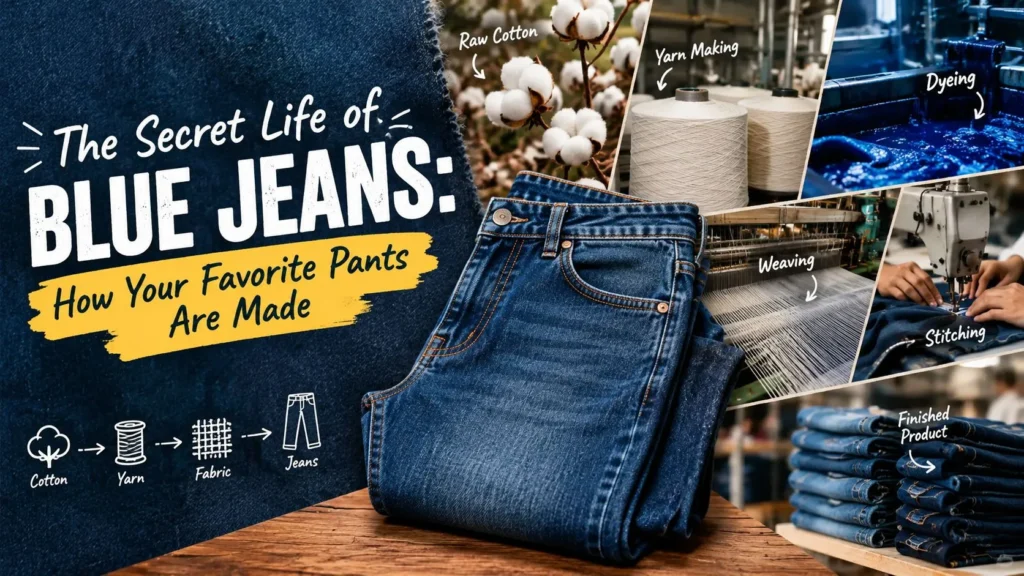
Turning a fluffy white plant into a strong pair of blue pants takes a lot of hard work. It happens in three big stages. First, factories spin the raw cotton into strong thread. Next, they dye the thread blue and weave it into stiff fabric. Finally, workers cut, sew, and wash the fabric to make the soft jeans you buy in the store. Let’s walk through how factories make your favorite pair of pants, step by step.
Step 1: From Cotton Plant to Strong Yarn
Every pair of jeans begins on a farm. Cotton is the secret ingredient behind great denim. Clothing makers love cotton because it is soft on your skin and lets air flow through. At the same time, cotton is surprisingly strong when you twist it together.
If you check the tag inside your jeans, you will likely see “100% cotton.” If you wear tight or stretchy jeans, you might also see a tiny amount—usually one or two percent—of a stretchy fiber like spandex or elastane. Factories mix this in so the jeans move with your body without feeling too tight.
The journey starts when the cotton plants are ready for harvest. Farmers drive giant picking machines through the fields. These machines pull the fluffy white cotton bolls right off the plants. At this point, the cotton is messy. It is full of seeds, dry leaves, and dirt from the field.
Farmers pack the messy cotton into huge blocks and send it to a cleaning plant. There, a machine called a cotton gin goes to work. The gin pulls the soft cotton fibers away from the hard seeds and crunchy leaves. Once the cotton is clean, workers press it into heavy blocks called bales and ship them to a thread factory.
At the factory, machines break open the bales and mix the cotton together. Then, they push the cotton through rollers covered in tiny wire teeth. This works just like brushing tangled hair. The wire teeth untangle the cotton and comb all the tiny fibers so they point in the exact same direction. The cotton comes out of this machine looking like a thick, soft white rope.
Still, this soft rope is too weak to make jeans. If you pulled on it, it would tear right apart. To make it strong, spinning machines pull the cotton rope thinner and twist it tightly. Twisting the fibers locks them together, transforming the fluffy cotton into thick, tough yarn. Now, the yarn is strong enough to survive years of wear and tear—and it is ready for its famous blue color.
Step 2: The Secret Behind the Blue Dye
Most clothes get their color after the fabric is already made. For example, factories usually weave a plain white t-shirt first and dip the whole shirt into red or black dye later. Denim is totally different. Factories dye the cotton yarn before they weave it into fabric. Even cooler, they only dye half of the yarn blue. They leave the other half pure white.
To get that classic blue color, factories use a special dye called indigo. Hundreds of years ago, people made indigo dye by soaking leaves from a real plant in water. Today, factories mostly make indigo in a lab because it is faster and cleaner, but it works the exact same way.
The dyeing process looks like a giant science experiment. Machines bundle thousands of white threads together into thick ropes. Then, rollers pull these ropes through several big tubs of liquid indigo dye.
If you watched this happen in person, you would see something surprising. When the yarn comes out of the dye tub, it is not blue at all. It is bright yellow-green! As the wet yarn travels up into the open air, the dye mixes with the oxygen in the room. Right before your eyes, the green yarn slowly turns into a deep, rich blue. Workers dip the yarn and let it air out several times to make the blue color darker.
Indigo dye has another neat trick that makes blue jeans special. Most dyes soak all the way into the middle of a thread. Indigo does not do that. Instead, it only sticks to the outside of the cotton yarn, almost like a coat of paint on a white wall. If you slice a piece of blue denim thread in half, the middle is still completely white.
This is the secret to why your jeans look cooler the more you wear them. Every time you bend your knees, sit down, or slide your phone into your pocket, you rub away a tiny bit of that blue outer layer. Slowly, the bright white core starts to peek through. That is how jeans get those awesome, natural faded spots that match the way you move.
Step 3: Weaving the Fabric
Once the blue yarn dries, it is time to weave the actual denim fabric. If you have a pair of jeans nearby, flip the bottom of one leg inside out. You will notice that the outside of your jeans is dark blue, while the inside looks mostly white. That is not an accident. It happens because of how the weaving machine—called a loom—puts the threads together.
A loom uses two sets of threads to make cloth:
- The blue threads run up and down from top to bottom.
- The white threads shoot across from left to right.
Before the loom starts, workers coat the blue threads in a starchy liquid made from corn or potatoes. This makes the threads stiff and smooth so they do not snap while moving fast inside the machine.
Next, the loom weaves the two colors together. Instead of going over one white thread and under the next, the blue thread jumps over two or three white threads before dipping under one. Because the blue threads sit mostly on top, the front of the fabric looks blue. Because the white threads sit mostly on the bottom, the inside of your jeans looks white and feels soft against your legs.
Look really closely at your jeans, and you will also see tiny diagonal lines running across the fabric. That diagonal pattern comes from this special over-and-under weaving style. It packs the threads tightly together, making denim tough enough to slide across pavement without tearing right open.
Before the freshly woven fabric leaves the mill, workers run it through one last machine. This machine blasts the denim with hot steam and water, squeezing the fibers together. This step pre-shrinks the fabric right at the factory. Without it, your brand-new jeans would shrink two whole sizes the very first time you washed them at home!
Step 4: Cutting and Sewing the Puzzle
Most modern factories use wide, super-fast machines that shoot threads across the loom using blasts of air. However, some smaller factories still use antique looms from the 1950s. These old machines weave slower, narrower strips of denim with a tightly sealed edge that cannot fray—often marked with a single red thread. Jeans lovers call this “selvedge” denim, and people pay big money for it because it is made the old-fashioned way.
Now that the mill has finished the rolls of denim, trucks ship them to a garment factory. Here, workers turn the flat sheets of fabric into wearable pants. Making a single pair of jeans takes about 15 different pieces of cloth, plus metal buttons, zippers, and thread.
The cutting process looks like a giant cookie-cutter operation. Workers roll out long tables and stack dozens of layers of denim on top of each other. Next, a computer maps out all the parts—like the front legs, back legs, pockets, and waistband—fitting them tightly together so the factory wastes very little cloth. Then, high-powered lasers or sharp electric blades slice right down through the thick stack, cutting out hundreds of matching panels at once.
Once workers cut the pieces, they bundle them up and send them to the sewing floor. Making jeans is pure teamwork. One single person does not sit down and sew an entire pair from start to finish. Instead, the pants move down a fast assembly line where each sewer handles one specific task:
- One person stitches the back pockets onto the back legs.
- Another person sews in the zipper or button fly.
- A third person joins the front and back legs together.
Because people expect jeans to last for years, factories build them like armor. Ordinary clothing seams would rip under heavy stress, so denim factories use heavy-duty sewing machines with two or three needles at once. These machines fold the fabric edges over each other before sewing, creating the thick, sturdy seam you feel running down your inner leg.
Factories also add metal reinforcements to the spots that take the hardest beating. If you look at the corners of your front pockets, you will spot tiny copper buttons pressed into the denim. People call these rivets. Miners kept ripping their pockets off while carrying heavy tools and rocks, so Levi Strauss and Jacob Davis hammered metal rivets into the corners to lock the cloth down tight.
Finally, workers sew on the belt loops, stamp on the metal waist button, and stitch the tiny fifth pocket inside the right front pocket. Miners and cowboys used this tiny slot to protect their pocket watches—today, people mostly use it to hold coins or car keys!
Step 5: Giving New Jeans That “Lived-In” Feel
When a pair of jeans comes off the sewing floor, you might not want to wear it right away. At this stage, people call them raw denim. They are dark blue, stiff as cardboard, and can feel scratchy against your skin. While some denim fans love buying raw jeans and breaking them in by hand, most shoppers want pants that feel soft and broken-in from day one.
To fix this, factories send the jeans to an industrial laundry. The goal is simple: make brand-new jeans look and feel like you have owned them for five years, but do it in just a few hours.
Factories use a few clever tricks to get that soft, faded look:
- Washing with Rocks: Laundry workers dump dozens of jeans into giant washing machines filled with hot water and rough, gray volcanic rocks called pumice stones. As the machine spins, the rocks tumble against the denim. The rough stones scrape away parts of the blue dye and soften the stiff cotton fibers. This process is where we get the term “stone-washed jeans.”
- Laser Aging: In the past, workers had to rub jeans by hand with sandpaper to create faded thighs or knee marks. Today, modern factories use computer-guided lasers. A worker slips the jeans onto an inflatable mannequin, and a green laser zaps the fabric in seconds. The heat instantly burns away the outer layer of blue dye, creating hyper-realistic wear marks, lines near the hips (often called “whiskers”), and cool faded knees.
- Saving Water: Older washing methods used hundreds of gallons of water and strong chemicals for every single pair of pants. Today, better factories use laser fading, eco-friendly washing liquids, and tiny bursts of water mist. These new tools give jeans the exact same vintage style while using up to 90% less water.
Once the jeans finish their wash, workers drop them into giant drying machines. When they come out, the stiff cardboard feel is completely gone—leaving behind soft, comfortable blue denim that is ready to wear.
People Also Read
The Accidental Invention of Denim Jeans